Abraham Lincoln My Childhoods Home I See Again
Background
Poetry is not a turning loose of emotion, merely an escape from emotion; it is not the expression of personality, only an escape from personality. Only, of course, merely those who have personality and emotion know what information technology ways to want to escape from such things .
- T.S. Eliot
Whether Lincoln, during the course of his lifetime, wrote millions of words, or only hundreds of thousands, ane stark fact emerges: less than a chiliad of them had to do with the quarter of his life he spent growing upward in Spencer County, Indiana. This letter and accompanying poem contains so, roughly half of what the nigh literary of all American presidents would write on the virtually unmentioned field of study of his childhood. It is a seminal business relationship, and in it, may exist found both the cause, and consequence, of his profound reticence.
It is non surprising, actually, that so vast a globe as childhood'south formative emotions would, past Lincoln, be couched in the verbal equivalent of nutshells: under discussion, then, is poetry. Lincoln reports he has not yet read Poe's "The Raven; enjoyed, nonetheless, a parody of it, "The Pole-Cat", lately published in the Quincy Whig; and thinks William Knox's dirge-like "Bloodshed", superb. Indeed, he declares, he "would requite all I am worth, and go in debt, to be able to write" such a work. No dubiety its lugubrious references to a dead mother and child, brought next to mind his own limerick; and hither Lincoln, in explaining its origins, mentions the virtually unmentionable: those two sudden and terrible losses, of his dear mother when he was ix, and of his sister a decade later.
The piece of poetry of my own which I alluded to, I was led to write under the following circumstances. In the fall of 1844, thinking I might aid some to carry the Country of Indiana for Mr. Dirt, I went into the neighborhood in that Country in which I was raised, where my mother and only sister were buried, and from which I had been absent about fifteen years. That part of the state is, within itself, every bit unpoetical as any spot of the earth; but nevertheless, seeing it and its objects and inhabitants aroused feelings in me which were certainly poetry; though whether my expression of those feelings is poetry is quite some other question. When I got to writing, the change of subjects divided the matter into four little divisions or cantos, the kickoff only of which I send you now...
Lincoln mentioned but ane other time, in writing, the decease of his mother and never, but hither, his sister. Indeed, except for three scant campaign-generated autobiographical references; a brief response, to an erstwhile Spencer County, Indiana employer, about canvassing there as the Republican nominee; and this, the nigh revealing of all his words on the subject field - expressed, chiefly, in verse - nothing, apparently, could adequately describe, as a man, what he felt as a boy, growing upward in Indiana. All he had to say, plain, he said here, as follows:
My childhood home I run across over again, O Memory! thou midway world And, freed from all that's earthly vile, Every bit dusky mountains please the eye As leaving some grand waterfall, Virtually xx years have passed away Where many were, simply few remain The friends I left that parting day, I hear the loved survivors tell I range the fields with pensive tread,
And sadden with the view;
And still, equally retention crowds my brain,
In that location'due south pleasure in it too.
'Twixt globe and paradise,
Where things decayed and loved ones lost
In dreamy shadows rise,
Seem hallowed, pure, and bright,
Similar scenes in some enchanted isle
All bathed in liquid lite.
When twilight chases day;
As bugle-notes that, passing by,
In distance die abroad;
We, lingering, list its roar—
Then retentivity will hallow all
We've known, merely know no more.
Since here I bid goodbye
To woods and fields, and scenes of play,
And playmates loved so well.
Of old familiar things;
Merely seeing them, to mind again
The lost and absent brings.
How changed, every bit time has sped!
Young childhood grown, potent manhood grey,
And half of all are dead.
How nought from death could save,
Till every sound appears a knell,
And every spot a grave.
And step the hollow rooms,
And feel (companion of the dead)
I'm living in the tombs.
Lincoln's sense that he lived in the tombs of his youth, did non go unnoticed. From his primeval days to the last haunted photograph, he was seen equally veritably dripping misery as he walked. "No element of Mr. Lincoln's character," a colleague declared, "was so marked, obvious and ingrained every bit his mysterious and profound melancholy." Why that was then, this letter and poem advise, was his life in Indiana, "where things decayed and loved ones lost."
Autograph Alphabetic character Signed ("A. Lincoln"), incorporating the Autograph Manuscript of his verse form beginning "My childhood home I see again", four pages, quarto, Tremont, Illinois, April 16, 1846. To Andrew Johnston.
Read More than
- Usa Presidents [+]
- Abraham Lincoln
- Lincoln, Abraham
- Family
- Literature
- Women
- Loss & Sympathy
- Letters
all pages and transcript
Folio 1/4

Tremont, April eighteen - 1846.
Friend Johnston:
Your letter, written some six weeks since was received in due grade; and likewise the newspaper with the parody -- It is true, as suggested it might exist, that I accept never seen Poe's "Raven'' --; and I very well know that a parody is almost entirely dependent for its interest upon the readers [sic] acquaintance with the original -- Yet there is enough in the pole cat, self-considered, to afford ane [text is crossed out] several hearty laughs -- I think four or 5 of the last stanzas are decidedly funny -- particularly where Jeremiah "Scrubbed, and done, and prayed and fasted'' --
I have not your letter now before me; but from memory, I think you lot ask me who is the author of the piece I sent yous; and that you so ask every bit to indicate a [text is crossed out] slight suspicion that I myself am the author -- Beyond all question, I am not the author; I would give all I am worth, and go in debt, to be able to write so fine [text is crossed out] a piece as I think that is -- Neither do I know who is the author -- I [text is crossed out] met it in a straggling class in a paper last summertime; and I think to have seen information technology once before, about xv years before; and this is all I know about it --
The piece of poesy of my ain which I alluded to, I was
Page 2/4
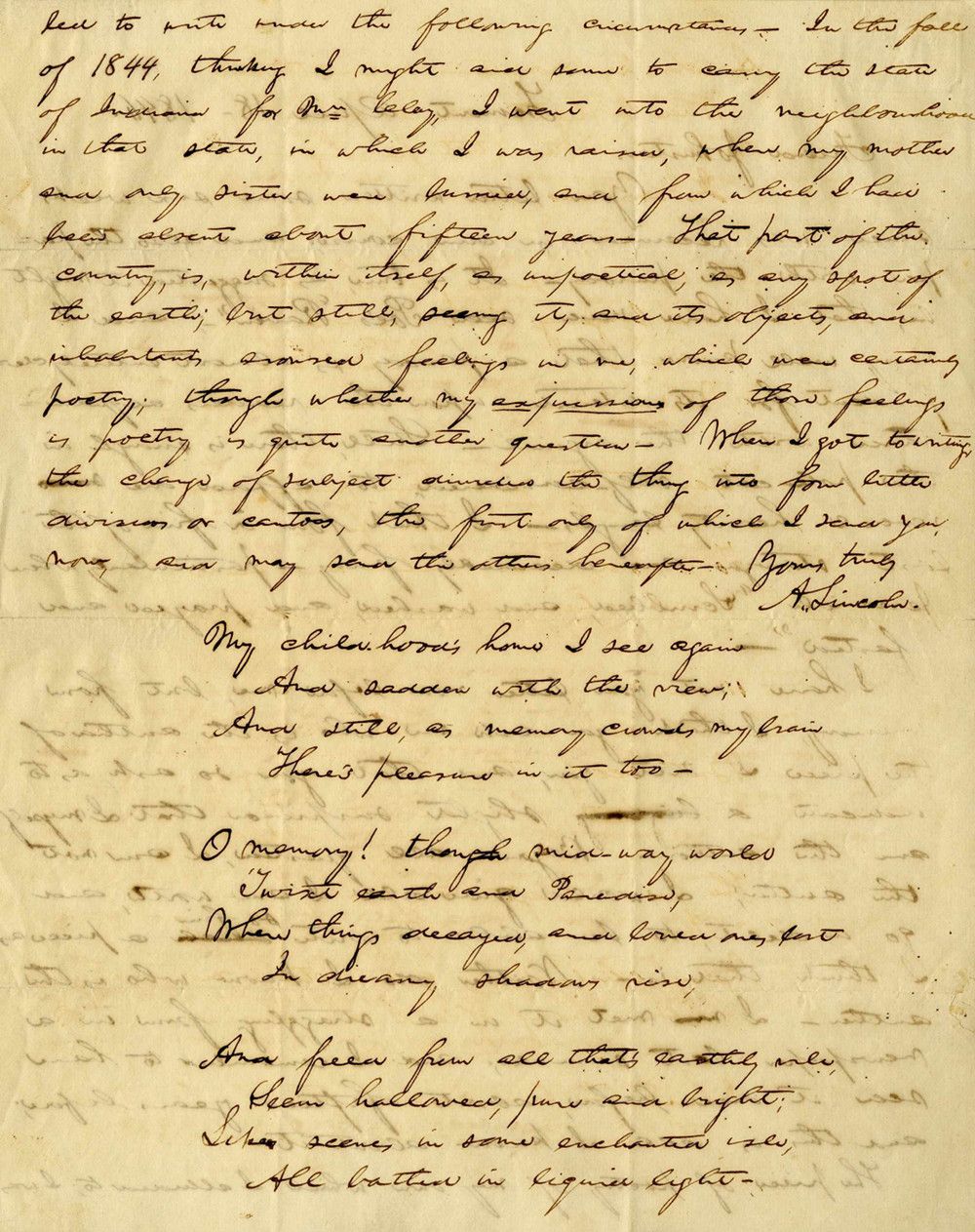
led to write nether the following circumstances -- In the autumn of 1844, thinking I might aid some to bear the state of Indiana for Mr Dirt, I went into the neighbourhood [sic] in that state, in which I was raised, where my mother and just sister were buried, and from which I had been absent nearly fifteen years-- That part of the country is, within itself, as unpoetical, every bit whatever spot of the earth; only still, seeing information technology, and its objects, and inhabitants aroused feelings in me, which were certainly poetry; though whether my expression of those feelings is poetry is quite some other question -- When I got to writing, the alter of subject divided the affair into four petty divisions or cantos, the first only of which I transport y'all now, and may send the others time to come --
Yours truly,
A. LINCOLN.
My childhood's home I run across again
And sadden with the view;
And still, equally memory crowds my encephalon
There'south pleasure in it besides --
O retentiveness! though mid-mode world
'Twixt earth and Paradise,
Where things decayed, and loved ones lost
In dreamy shadows rise,
And freed from all that's earthly vile,
Seem hallowed, pure and bright;
Like scenes in some enchanted island,
All bathed in liquid light --
Folio 3/4
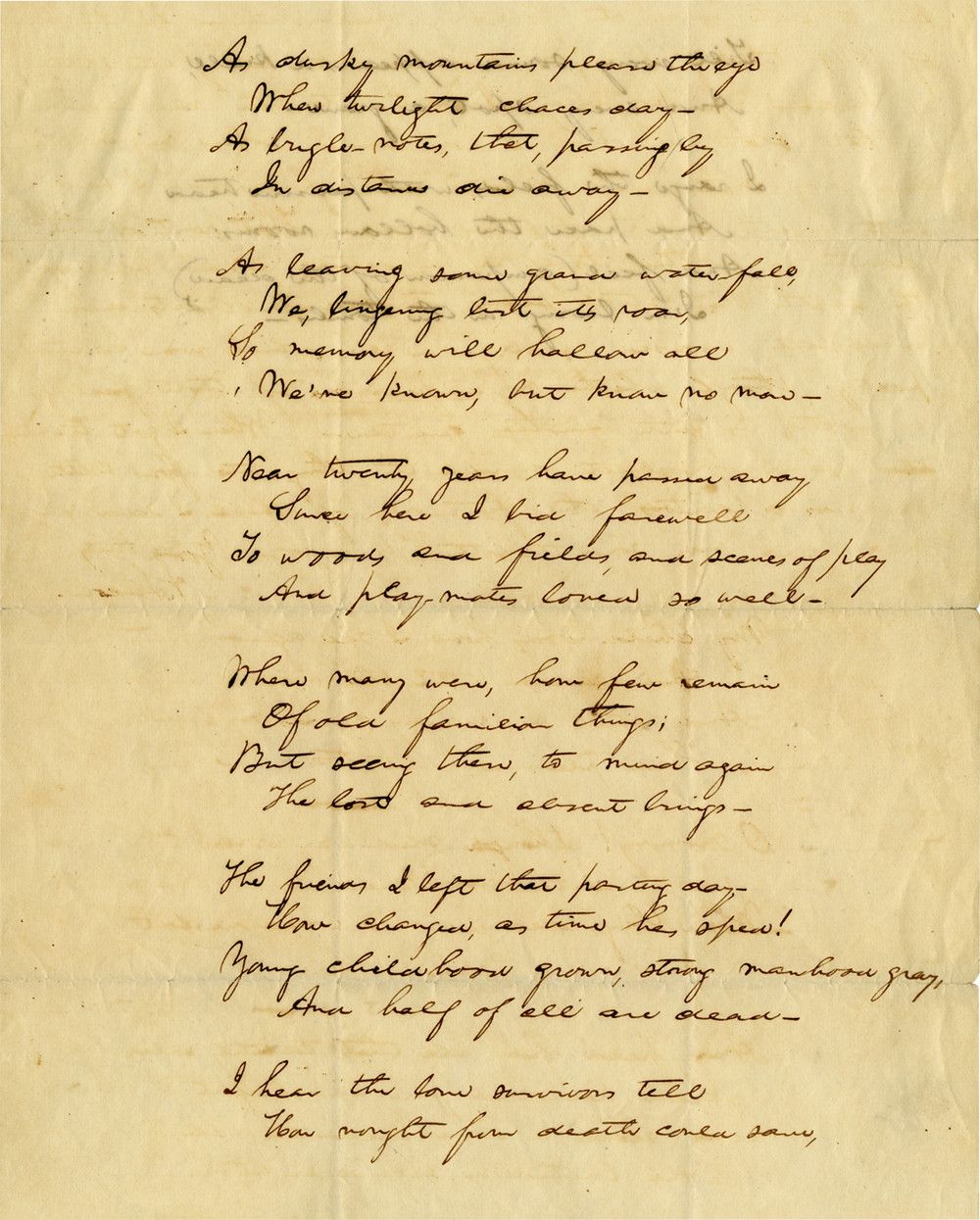
Equally dusky mountains please the eye
When twilight chases day --
As bugle-notes, that, passing past
In distance die away --
Equally leaving some yard waterfall,
We, lingering list it's [sic] roar,
So memory will hallow all
Nosotros've known, but know no more than --
Nigh xx years have passed away
Since hither I bid farewell
To woods and fields, and scenes of play
And play-mates loved so well --
Where many were, have few remain
Of old familiar things;
But seeing and then, to heed again
The lost and absent brings --
The friends I left that departing day --
How changed, equally fourth dimension has sped!
Young childhood grown, strong manhood greyness,
And half of all are dead --
I hear the lone survivors tell
How nought from death could relieve,
Page 4/4
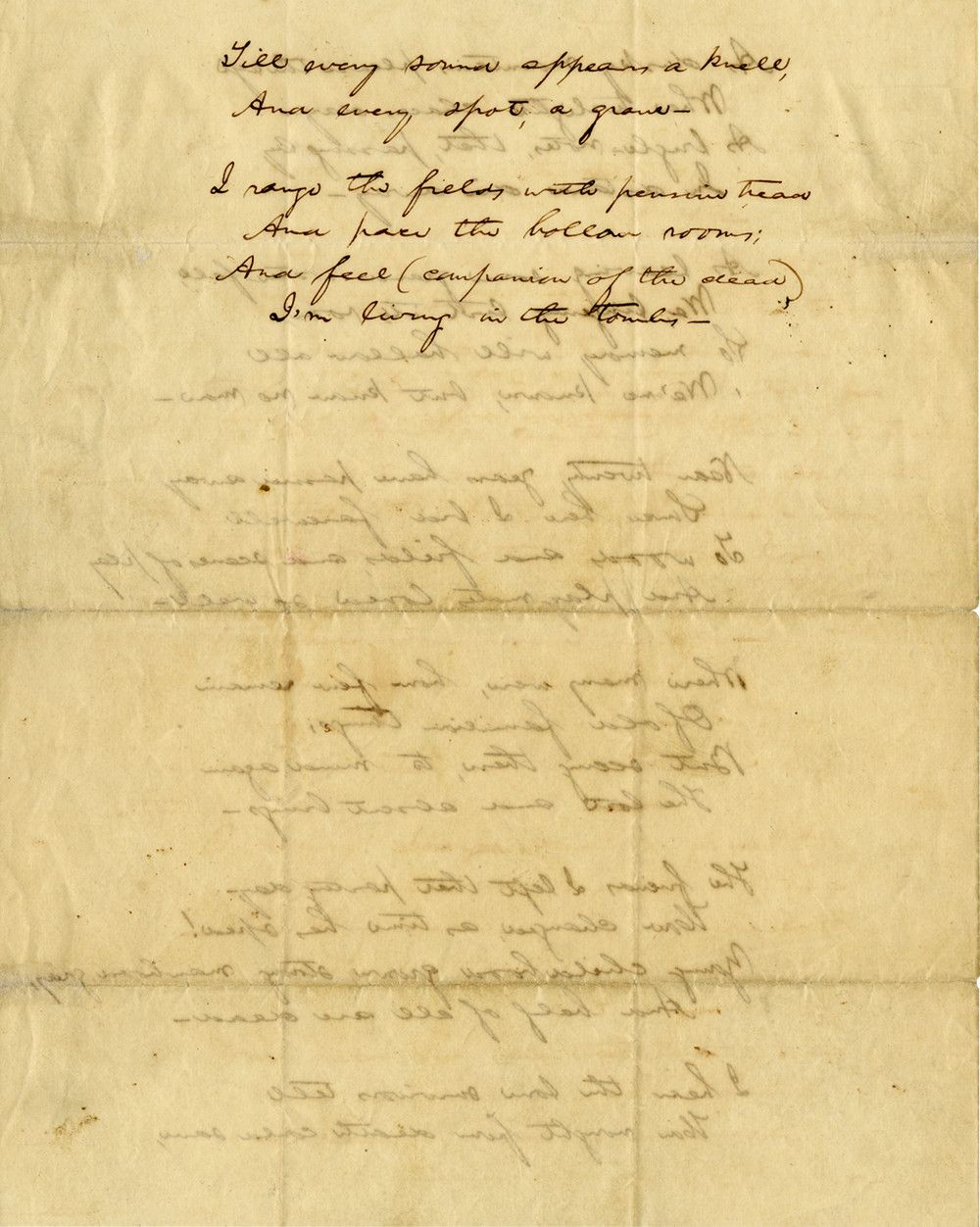
Till every sound appears a knell,
And every spot, a grave --
I range the fields with pensive tread
And stride the hollow rooms;
And feel (companion of the dead)
I'grand living in the tombs --
Source: https://www.shapell.org/manuscript/abraham-lincoln-poem-on-childhood-death-of-mother-and-sister/
0 Response to "Abraham Lincoln My Childhoods Home I See Again"
Post a Comment